

 Last Updated On: 21 September 2025
The posture of a dour adolescent illustrates a depressive state where shoulders are slumped forwards onto the chest and the head is held low.
Perhaps the clip serves to demonstrate how teenagers mood swings are often open to ridicule when it makes others feel uncomfortable. And sometimes it’s easier to ignore it or write it off as a phase.
But statistics show that without a parent, teacher or some form of committed support around 80% of teenage depression goes by unrecognized, dismissed, or unaccepted.
Does posture really make a difference?
In Yoga the lowered chin is identified as the depressive posture, but if you have this condition, you might want to try the yoga posture to see if you can feel any difference (and of course if this is your thing) I’m expecting you to poo-poo it lol, but if you are willing, this is how:
- Stand and simply lift the head, not so high that the eyes look up to the ceiling but somewhere in-between, where the head is straight and the eyes look forward
- Looking the world in the eye can change a mood, sounds corny, but by being sensitive to it, you may become aware of an alteration or two (it’s subtle). It can affect our gait (the way we walk) and the voice (how we talk) to name but two
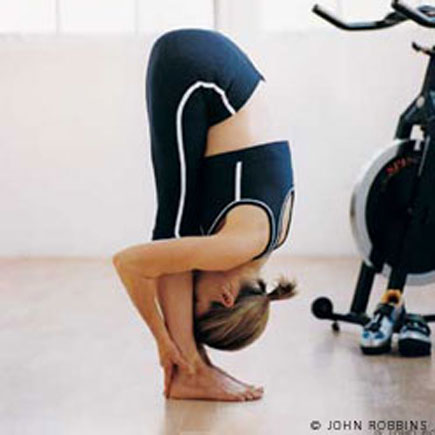
- The Standing Forward Bend (Uttanasana) has a calming effect on the brain and nervous system and is good for stress and mild depression. It’s a start.
The pose
Stand in Tadasana, gently exhale and start to bend forward from the hip joints, but only when the breathe allows.
It’s important to stay with the breathe but that the breathe isn’t forced, which takes practice to develop.
This is not about seeing how far forward (or low) you can go, instead it’s about bringing your awareness to what the body allows as you move into it.
Rigidly positioning yourself defeats the purpose as other parts of the body will take the pressure and the benefits are lost.
Feel the torso as it releases and just allow it, no pressing, or holding just releasing and breathe.
You might get a sense of the sitting bones (in the bum) pointing towards the ceiling).
With each inhalation sense a lifting and lengthening around the front torso, it’s subtle; and see if you can sense as each exhalation allows you to release a little more into the forward bend.
Allow the head to hang from the base of the neck, where there’s a sense of it between the shoulder blades.
Roll the spine to come up. Bring your hands back onto your hips and reaffirm the length of the front torso. Then gently press your tailbone down and into the pelvis and come up on an inhalation feeling the elongation in the front body.
Feels good doesn’t it, and if it’s the first time you’ve carried out Tadasana in this way, you’ll definitely notice the difference it makes in tuning into your body.
Taking some proactive steps towards getting free of those downward spiraling feelings are key to having a different quality of life day-to-day.
Even if you’re allergic to exercise lol, or prefer to pound it out with an intense regime, incorporating some yoga, meditation, tai chi, or Pilates only adds to your commitment for change. And I guarantee you’ll notice the difference over time, as you develop more flexibility and suppleness.

PS: I’d love to support you in getting rid of what’s not floating-your-boat, so that you can learn how to change what works against you and start tapping into your full potential.
Step up to the mark
Are you feeling ready to ditch the emotional roller-coaster, because this approach brings about a significant and noticeable difference?
Now click through on the button below and arrange a 20-min chat to put an end to the run of what’s no longer working in your favour.

 Health challenges in early childhood kick-started a Sherlock curiosity in cause and effect.


Leave a Reply