

 Last Updated On: 4 September 2019
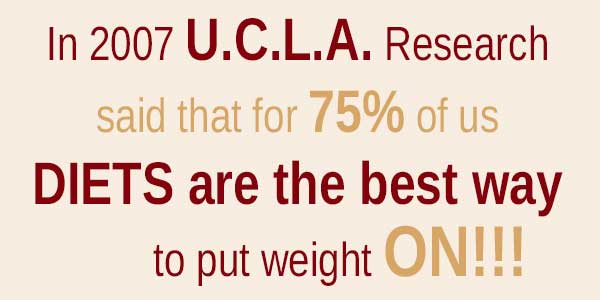
Here’s the deal, if you’re among the 22-25% of people who diet and are successful, a. you’re probably not even reading this, unless it’s on someone else’s behalf, and b. you made lifestyle changes in your habits that meant your long-term weight loss efforts were successful and you managed to maintain them.
But if you’re among the 75-78% who haven’t been successful in changing your shape for the better, then it’s unlikely to work with whichever programme you chose. Because it’s not the programme.
There I said it, BUT it’s not your fault either!
Why you’re not losing weight
Getting behind what’s going on is the best way forward when dieting hasn’t got you to where you thought you would be. And in a sense this provides the steps you need to take BEFORE choosing a diet, that would make your dieting efforts so much easier. And in many cases the weight falls off and a dieting plan becomes unnecessary.
In simple terms, it’s habitual programming, that turned into a coping strategy, and once you change that everything else just falls into place. Weight loss in of itself often becomes a side effect, without putting the effort in. This is what Kelly said:
“For as long as I remember I experienced food cravings which always led to binge-eating on a daily basis, followed by feelings of guilt and shame. But as soon as I started the programme, big changes happened, where I stopped constantly thinking about the next meal, and sweet things. My cravings vanished, and I was delighted as the weight fell off. Jane was easy to talk to, I didn’t feel judged, and she was very intuitive.”
What you can do instead
When it comes to achieving a successful long-term outcome for your weight loss goals you have to put the work in, the real elephant in the room is that:
There are no shortcuts!
And I don’t think that comes as any surprise does it? But what might be new to you is to realise that if you’re among the 75-78% of people that this applies to, in other words his isn’t news to you, right?
So let’s look at that little nugget and move into what can be done to make these changes into a gentle process. Lifestyle alterations are simple, when you know how, and getting rid of what drives your unwanted patterns of behaviour in the first place, is where your real changes can happen.
When nothing works
What if you feel you’ve tried time and time again without making any real headway, what then? Where you focus your efforts is what counts, otherwise you might be chasing your tail for the longest time.
And the fact that you’re here means that at the very least you know only too well how frustrating it is to put in lots of effort and get very little if anything back, over time.
There is so much evidence showing the shortfalls of dieting regimes, and for all manner of reasons like; nutritional depravity, untried, untested, some-one else’s business emporium. And no judgement here, but systems either work or they don’t. And you get to know that quite quickly, because you feel different, and it’s effective.
Obtaining an effective outcome
And with weight loss you actually see it in real measurable terms, because if it’s working You Lose Weight which makes it very simple to gauge.
Not only will the pounds fall away, but, as the tagline above shows, the stress does too. It should transform you into a less stressed and happier person. But not only that the weight will stay off if you’ve made the lifestyle changes and dealt with the triggers.
The UCLA
The UCLA are an institution that has researched the dieting industry to within an inch of it’s preverbials, 60+ years and counting. Time and again they tell us that diets don’t work for around three quarters of people, which is in itself a large number, wouldn’t you agree.

In 2007 after following 30+ dieting regimes, running over 2-5 yrs, the UCLA announced that between 75-78% of people have not only put the weight back on, but they became heavier.
Here’s a recording of the newscast (it has a surprisingly in your face approach):
Scientific American – 60-second science… Although the comments were flippant at the end of the recording, “you have to eat less, stupid”, there is more to it.
And I think it’s in light of this and other critiques of what is a multi-billion pound industry that mainstream dieting companies, like Weight Watchers and Slimming World are endeavouring to incorporate some of the understandings into their programmes.
They’ve introduced more mindset coaching, goal-setting, planning your outcome, etc, and Slimming World’s move into what appears to be the Combination Eating System, they are rising to their critics.
There’s only so long you can blame the customer for a product now working. And there’s no doubt that weight loss is a complex animal.
Making authentic lifestyle changes
As much as market forces are leading these companies to change it up a bit, they still don’t fully incorporate the understandings we have now about the mind and body connection, yet how can we separate these components because we’re not robots, however much we might try to compartmentalise our lives.
But one thing you’re never going to hear those companies say it that:
It actually doesn’t matter what you eat, because food is not where the problem lives
And therein lies the rub.
Is dieting working for you?
The thing about dieting is that some people have a great experience on one, because they are part of the 22-25% population who have reached their target and have a successful outcome. But be wary, because when it comes to an eating plan there are so many components and what brings Person A a resounding success does not necessarily do the same for Person B.
However when it comes to eating plans, you may well have some things you particularly like, and this is the most important thing of all; listen to yourself, your body and your mind.
Take more notice of what you like, develop your own tastes and stop looking to other people, and their preferences for answers.
Be experimental, and start to incorporate more of what works for you, in getting the results you want, which is what really counts. Be more mindful about setting yourself up to create better habits, rather than being distracted by what’s good and what’s bad.
The truth is there is no such thing, especially when you follow the principle of All Things In Moderation.
The only time you would really need to allow yourself a restricted eating plan is when you’re recovering from illness, especially where long-term recuperation is involved.
Adding the mindset component
Changing your mindset is vital, because it’s the only way to retrieve your best energy, vitality and return to glowing good health. Making all of the above easier to achieve, developing your personal self esteem, is part of getting into a healthy state with healthy habits.
Jane
Step up to the mark
PS – Directing your own destiny begins by arranging a quick 15-min chat which kick-starts having more energy to develop what you really, really want.

 Health challenges in early childhood kick-started a Sherlock curiosity in cause and effect.


Leave a Reply