

Let’s get 2010 off with a bang … It’s time to get down to some deep and meaningful … exercise that is 🙂 … and for my money there is nothing better than a good session of Yoga … especially the not too fearsome variety … It need not be strenuous to be effective … a great learning for us all! And one that took me quite a while to realise … in life as it is in Yoga lol!
The most well known posture in Yoga is probably the Down Face Dog, which usually sits in the centre of a Yoga class … the group will have warmed up to it because it stretches everything. Most sessions include it a bit like an old favorite, and it may well be followed by some even more advanced poses such as the shoulder and headstands that often conclude a class.
Because it stretches everything, care is key. It’s so easy to go into the Down Face Dog incorrectly, you see it all the time in films. Just getting into the pose from the usual position of being on all-fours, on the mat and of course there are other ways, such as the forward bend, is where an awareness starts.
Quite often people just lift from the lower to mid-back region to take the arms and legs into full stretch. The best way to protect the lower back is to push back into a semi-squat taking the legs up that way.
The posture
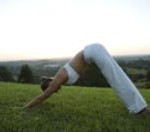 Once in the pose its important to become aware of the lower back, and bring it in line with the flat of the rest of the back, rather than a common tendency to over-extend or invert. The neck should not drop too heavily but instead align with the rest of the spine, while simultaneously opening the chest and keeping the shoulders as far away from the ears as possible.
The feet
The pose comes from the feet and legs and its more useful to keep the feet flat, with a shorter reach between the feet and hands than it is to stretch the body out and have the heels not touch the ground. The benefits of the ‘shorter dog’ far outweigh the alternative, as the grounding through the legs and feet will over time enable a wider stretch between the feet and hands than does wobbling and not being grounded at all when the heels sit mid-air. And if nothing else its more encouraging for the participant.
Be careful not to stay for too long in pose, in a competitive way, but similarly stay for a little longer than you think you can. And relax!
Yoga pose
The most well known posture in Yoga is probably the Down Face Dog (DFD) … It usually sits in the centre of a Yoga class … the group will have warmed up to it because it stretches everything. Once completed, and most sessions will include it like an ‘old favorite’, is followed by the more advanced poses such as the shoulder and headstands that often headline a class.
Because it stretches everything, care is key. Its so easy to go into the DFD wrongly. Just getting into the pose from the usual position of being on all-fours, on the mat and of course there are other ways, such as the forward bend, is where an awareness starts. Often people just lift from the lower to mid-back region to take the arms and legs into full stretch. The best way to protect the lower back is to push back into a semi-squat taking the legs up that way.
The posture
Once in the pose its important to become aware of the lower back, and bring it in line with the flat of the rest of the back, rather than a common tendency to over-extend or invert. The neck should not drop too heavily but instead align with the rest of the spine, while simultaneously opening the chest and keeping the shoulders as far away from the ears as possible.
The feet
The pose comes from the feet and legs and its more useful to keep the feet flat, with a shorter reach between the feet and hands than it is to stretch the body out and have the heels not touch the ground. The benefits of the ‘shorter dog’ far outweigh the alternative, as the grounding through the legs and feet will over time enable a wider stretch between the feet and hands than does wobbling and not being grounded at all when the heels sit mid-air. And if nothing else its more encouraging for the participant.
Be careful not to stay for too long in pose, in a competitive way, but similarly stay for a little longer than you think you can. And relax!
Jane

PS: I’d love to support you in getting rid of what’s not floating-your-boat, so that you can learn how to change what works against you and start tapping into your full potential.
Step up to the mark
Are you feeling ready to ditch the emotional roller-coaster, because this approach brings about a significant and noticeable difference?
Now click through on the button below and arrange a 20-min chat to put an end to the run of what’s no longer working in your favour.

 Health challenges in early childhood kick-started a Sherlock curiosity in cause and effect.


Leave a Reply