

 Last Updated On: 4 September 2019
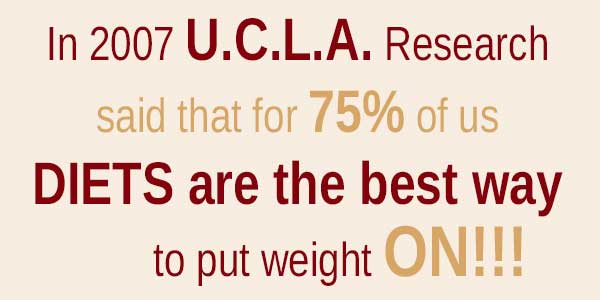
In 2007 after following 31 dieting regimes, following subjects for between 2-5 yrs, the UCLA announced that only 22-25% of people have successful outcomes with diets, the rest of us not only put the weight back on, but we often become heavier.
Surprising isn’t it? Here’s the announcement made by the Scientific American during a 60-second science news item.
Although the comments were flippant at the end of the recording, “you have to eat less, stupid”, you’ll know if you’re reading this, that when that philosophy isn’t working, then there’s more going on under the-hood.
And in my experience of working with countless clients weight loss often has a range of tiers to it, especially when the patterns have been going on for a long time. So get ready to explore those here, and see which apply to you.
Let’s also be mindful that a multi-billion dollar industry comprising of; fitness, dieting, refined food manufacturing and government bodies loathe to implement across the board product labeling. And en-masse why would they even want to find better, healthier solutions, preventative care, education and awareness.
Soapbox aside, don’t know what came over me :). But on a more serious note collectively it’s an industry that feeds on people’s insecurities, self-image, low self-confidence, while encouraging us to feel crap about our body. And the media at large plays into it.
This makes blaming the customer when their product isn’t working, such an easy target. We need them to put their money where their mouth is. And that’s what I’m prepared to do here, so let’s dig in and see what else is going on for you with this.
What approaches are you taking?
Are you using short-term measures for what has become a long-term project, you’d better think again if you want to make this the last time?
Here’s the deal, if you’re among the 22-25% of people who diet and are successful, a. you’re probably not even reading this, unless it’s on someone else’s behalf, and b. you made lifestyle changes in your habits that meant your long-term weight loss efforts were successful and you managed to maintain them until they became the new habit.
If you’re among the 75-78% who haven’t been successful in changing your shape for the better, then it’s unlikely to work with whichever programme you chose.
Because. The. Programme. Doesn’t. Touch. The. Sides.
There I’ve said it, and it’s not your fault either! And that is the really, really good news, because this information, is what makes any habit REVERSIBLE!
When nothing works
When you’ve tried to keep weight off time and again without making any real headway, what then? You’ll have guessed by now, that the solution requires something else to be added to the mix.
Where you focus your efforts is what counts, otherwise trying the same thing over and over without reaching the results you want, and you’ve every right to expect, won’t happen.
The fact that you’re here means you know only too well how frustrating it is to put in lots of effort and get very little if anything back, over time.
And there’s a mass of evidence showing the shortfalls of dieting regimes, which we’ll take to apply to the 75-78% (of people the UCLA identify as being failed with them) for all manner of reasons:
- Unbalanced dietary content
- Out-of-sync eating
- Confusing the metabolism (a delicate mechanism at best)
- Returning to poor eating habits
- Sorting out your eating but then something else pops up
- Not relating other health issues
- Not addressing the other factors, i.e. job, relationships, etc
- Not making substantial enough lifestyle changes
The last three are imperative, crossing-over with the urge to overeat. In real-terms, it’s quite easy to see if a system has worked for you or not. Just as people judge you or you judge yourself for your size, you know that if a programme suits you, you’ll easily lose weight at the general rate. Easy peasy! I hope we agree on the classic formula for steady, healthy fat and water loss:
You’ll easily adapt to a programme and find you’re losing approx 7 lbs a month, that equates to approx 84 lbs a year.
And seriously if that’s not happening, you can be sure that something else needs including.
And you’ll know it quite quickly, because once things are flowing in the right direction, you’ll start measuring it’s effectiveness through these indicators:
- You’ll feel differently
- The stress will fall away
- Your taste buds will change
- You’ll stop obsessing over food
- You’ll no longer need to cheat (yourself)
- You’ll stop craving high salt, refined sugar and saturated fat snack-products
- You’ll lose the charge that food-cravings had over you
Why you’re not losing weight

Getting behind what’s going on is the best way forward when dieting hasn’t enabled you to reach a reasonable target, reasonable being defined by not expecting at 50 to recover the figure you had at 18.
Even when your best friend can still fit into her wedding dress, it’s probably because she hasn’t found her coping-strategies in food, or been on and off diets for most of her adult life.
This alone has been costing you a hefty price, in one way or another. But where this has been an ongoing issue, for longer than you care to remember, then what you’ll find here provides the necessary steps required to take BEFORE choosing a diet, that would make your weight loss efforts far easier.
In simple terms, if you’re not losing weight it’s because you have some habitual programming running subconsciously, and once you change that everything else just falls into place, weight loss often turns into a side benefit, without having to try.
You can then get on with whichever method of eating truly suits you without being hampered, and those of us with this type of history like the structure of a healthy prescriptive eating programme.
What’s really going on
In fact this is what happened for Kelly when we worked together on her eating habits:
Weight Loss
“For as long as I remember I experienced food cravings which always led to
binge-eating on a daily basis, followed by feelings of guilt and shame.
But as soon as I started the programme, big changes happened
where I stopped constantly thinking about the next meal, and sweet things.
My cravings vanished, and I was delighted as the weight fell off.
Jane was easy to talk to I didn’t feel judged and she was very intuitive.”
Kelly Sanguiseppe | Dance Teacher | Colonic Hydrotherpist
Making lifestyle changes
Depending on your starting point, most people look to change their weight in order to feel better, retrieve their energy and get into better shape.
But sometimes what’s more of an indication is how you’re eating rather than what you’re eating that follows on from… sporadic eating after years, sometimes decades of changing eating programmes, slimming, not slimming, having children, going through big life changes, divorce and separation, ugly childhood’s, bereavement, and more.
When food is where you turn whether you’re happy, sad, lonely or bored, you can become part of the quarter that diets work for once you change what’s driving the bus behind those behaviours.
And that is SO much easier, gentler and effective when you use the sorts of tools and techniques I’ll introduce you to.
Tools that you have at your disposal long after working together, because they are handy to have to help yourself, your kids, your partner and other nearest and dearest. You basically become your own expert.
It’s not your fault
It’s also worth keeping this in mind, because when it comes to eating plans, you may well have some things you particularly like, and this is the most important thing of all; listen to yourself, your body, your mind, and keep observing.
Take more notice of what you like, develop your own tastes, stop looking to other people, and develop your own style that works, nourishes you and gets you into a better physical, emotional and mental head-space.
Be experimental, and start incorporating more of what works for you, in getting the results you want, which is what really counts. Be more mindful about setting yourself up to create better habits, rather than being distracted by what’s good and what’s bad.
The truth is there is no such thing, especially when you follow the principle of All Things In Moderation.
Marc David the nutritional psychologist tells us the only time we really need to be on a restricted eating plan is while recovering from illness, especially where long-term recuperation is involved. I definitely agree with that.
What you can do instead
When it comes to achieving a successful long-term outcome for your weight loss goals you have to put the work in, the real elephant in the room is that:
There are no shortcuts!
And I don’t think that comes as any surprise does it?
But what might be new to you is to realise that if you’re among the 75-78% of people that the UCLA figures apply to, rethinking your approach is a very good starting point.
It’s an oldie but goodie that you’re probably already familiar with, but it’s worth repeating… Einstein’s definition of insanity is:
Doing the same thing over and over again and expecting a different result…
This is spot-on for the dieting world when we steel ourselves for yet another dieting bout, feeling more defeated each time we start again, expecting less of ourselves than we did previously. And who hasn’t been known to laugh it off, while feeling quite deflated inside.
What you can do instead
Let’s move into what can be done to make these changes into a gentle process. Lifestyle alterations are simple, when you know how, and getting rid of what drives your unwanted patterns of behaviour in the first place, is where real change happens.
With weight loss you experience it in very measurable terms, because if it’s working You Lose Weight which makes it simple to gauge.
Not only do the pounds fall away, but it will transform you into a less stressed, happier and healthier person, as you get more and more on-board with all areas in your life.
And the best news of all (rarely gets a mention) the weight will stay off if you’ve made enough appropriate lifestyle changes.
Adding the mindset component
Changing your mindset is vital, because it’s the only way to retrieve your best energy, vitality and return to glowing good health. And that’s where the services you’ll find here are key. Making all of the above easier to achieve, developing your personal self esteem, is part of getting into a healthy state with healthy habits.
There’s no such thing as a stress-free life, but learning the smartest tools for change makes all the difference and will ultimately equip you to become your own life expert.
Jane
Step up to the mark
PS – Directing your own destiny begins by arranging a quick 15-min chat which kick-starts having more energy to develop what you really, really want.

 Health challenges in early childhood kick-started a Sherlock curiosity in cause and effect.


Leave a Reply